
How to write a useful | interesting studio update? I don’t know, never done one. 2026 is a year of many firsts; some good, some not so much, but firsts are needed to stay sharp, even when they are uncomfortable.
In the last 2 months I started Under Over Through, built the website and began scouting for projects. The practical stuff is boring of course (and projects are unfortunately confidential) but the most interesting part was figuring out how to name things, what words to use to describe what I do, who I am, how to prioritize.
I don’t think I have all of this quite right yet. A friend working on a startup told me their investors said candidly they expected them to mess around for about a year before knowing what they are doing. A year feels like a geological era in the current environment but I guess they are somehow right. If you are doing something weird, it takes a bit of swimming around in the dark.
And dark (and cold) it was. This winter has been brutal in NYC. I don’t think we went above freezing for more than a month and everyone went into a bear-like torpor. Good weather for staying inside and building a hybrid human | AI infrastructure for the studio.
The first version of the hybrid studio
My position is simple: I’m not interested in fully autonomous workflows (why should agents have all the fun with me looking at the terminal like an aquarium?), instead I want a hybrid workspace where humans and agents alternate, picking up each other’s slack, expanding | completing | challenging it.
I have been experimenting with something similar to the approach recently popularized by Karpathy, though I slowly arrived at it from a different angle.
The system is simple too, and I think everyone could design their own rather than forking someone else’s. Designing it requires learning what you want | need.
For me it was:
A shared folder, synced across devices
Accessible to both a terminal agent (Gemini via Antigravity or Claude Code)
A structure that also works with Obsidian (Obsidian is good for browsing, reading IMO)
iAWriter for human editing (this is a very personal and unnecessary preference but I have used this since they first released and it’s the piece of software I use the most)
Connections as needed (for me it’s Gmail, Calendar, Miro, and Github)
Claude Cowork on the same folder for housekeeping (categorizing files and scans, deduping, structure maintenance)
A series of agents instructed to work daily or upon request:
@signal for emerging news and discussions
@researcher for deep dives, tagging, and linking all the material
@curator for speculative lists of events, reads, and deadlines
@scout for spotting opportunities (grants, residencies, etc.)
@dreamer for proof-of-concept prototyping
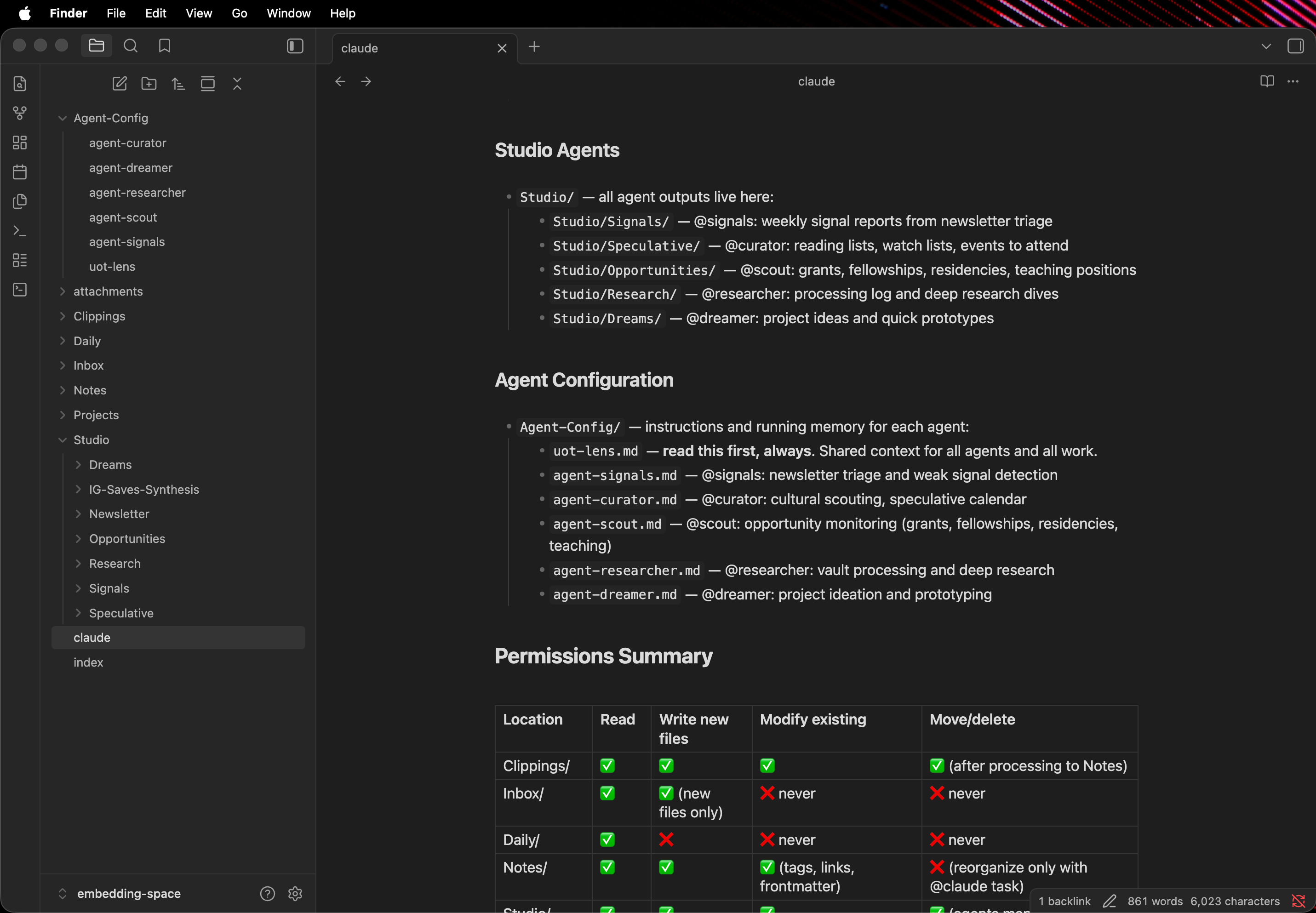
Perfect? No. Autonomous? Not in the way we often imagine it. Creative? I’m not sure. This is mostly the repetitive stuff but it helps me removing the burden of documentation. I might be fooling myself but I think the creativity is still in the ingredients that go in and what comes out at the end, not in the in-between workflows. I like that both humans and agents have access to the same content but use different tools to manipulate it, and especially that they do it at different times.
It is a nice morning ritual to know the same folder will have yesterday’s handwritten notes transcribed and augmented with a bit of research, or a suggestion for an article to read, or a quick and dirty prototype of one of the ideas. Like preparing the dough and putting it aside, letting it rise. Or coming back to a project war room and see post-its have been added, rearranged, new sketches on the board. None of this is the real deliverable, but it keep the curiosity running.
Experiments will continue here, with intention.
Walking ideas
I have been traveling (California, Sea Ranch and the Bay Area) and with better weather and more time to walk I kept returning to a few ideas. I find myself thinking that a lot of widespread unease | incomprehension | anger derives from our tendency (in some cases natural and in order purposefully manipulated) to bundle things together too tightly: identity and work, work and education, education and jobs, and so on in an all-encompassing loop (and the list could go on with other domains that are even more polarizing). What happens when we start to disentangle these concepts and reconsider them on their own history and merit? I think this is part of what I meant when I wrote that institutions and mental models are stale and losing their purposes under the weight of climate adaptation, demographic changes, and AI diffusion.
I’m deep into rereading The Dispossessed by Ursula K. Le Guin and I keep finding versions of ideas I thought I was working out for myself: the communal work system on Anarres, the permeable wall, the discomfort that a working utopia also conceals its dystopia. She was there fifty years ago, I wasn’t when I first read it!
Could ideas from fictions (old and new) be smuggled into the suboptimal reality we live in? Four-day work weeks are showing up as policy, as experiments, or necessity (as a consequence of the oil crises Bangladesh is implementing urgent energy-saving measures, including shorter office hours, closing shops earlier, and considering a four-day work week and increased remote work), people are wearing cameras to train robots. Could a lighter workload open a door to something communal? It seems silly to think about this in a moment where everyone is talking about 996 but these are the kind of prototypes I’m interested in right now.
Things that caught my eye
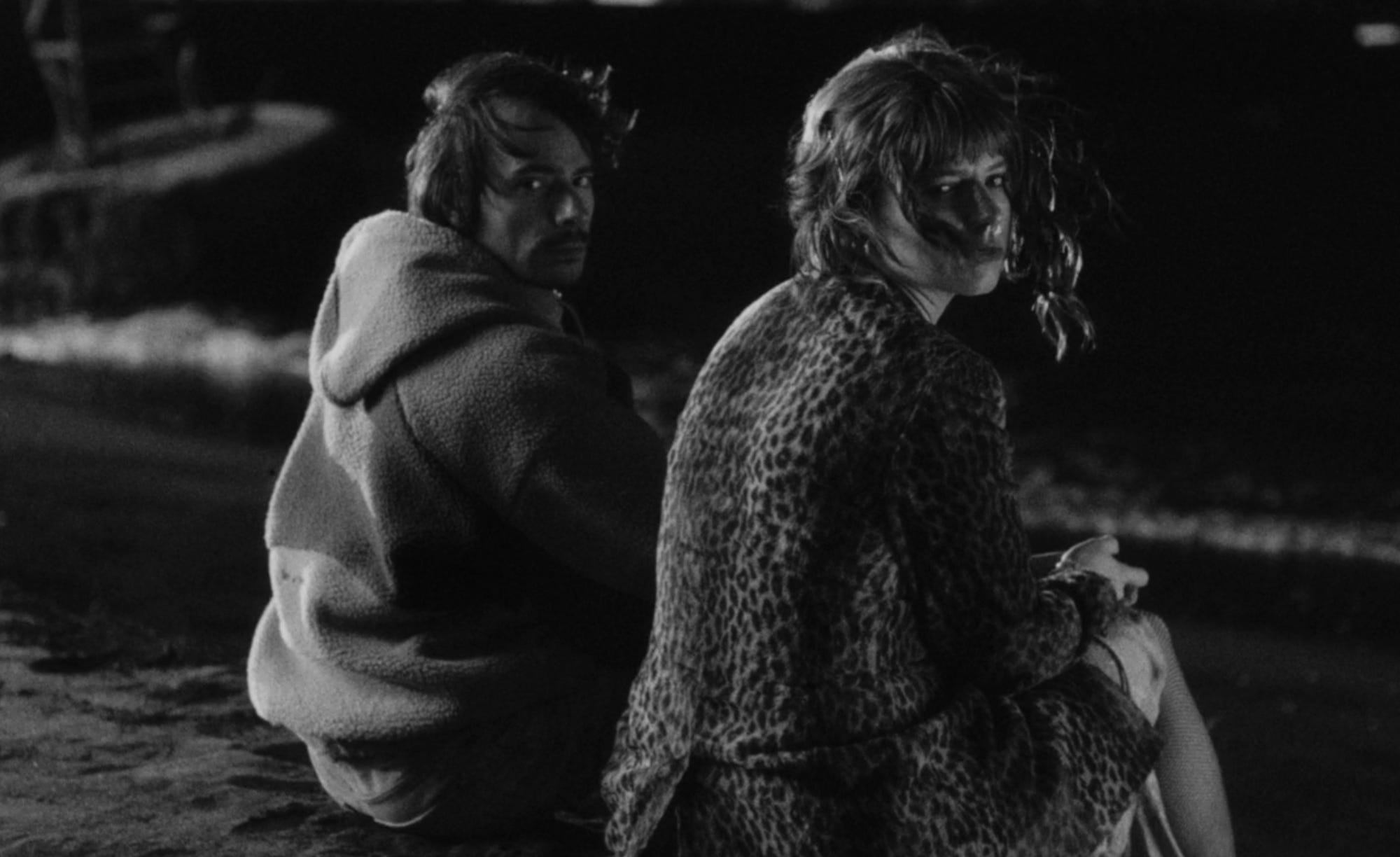
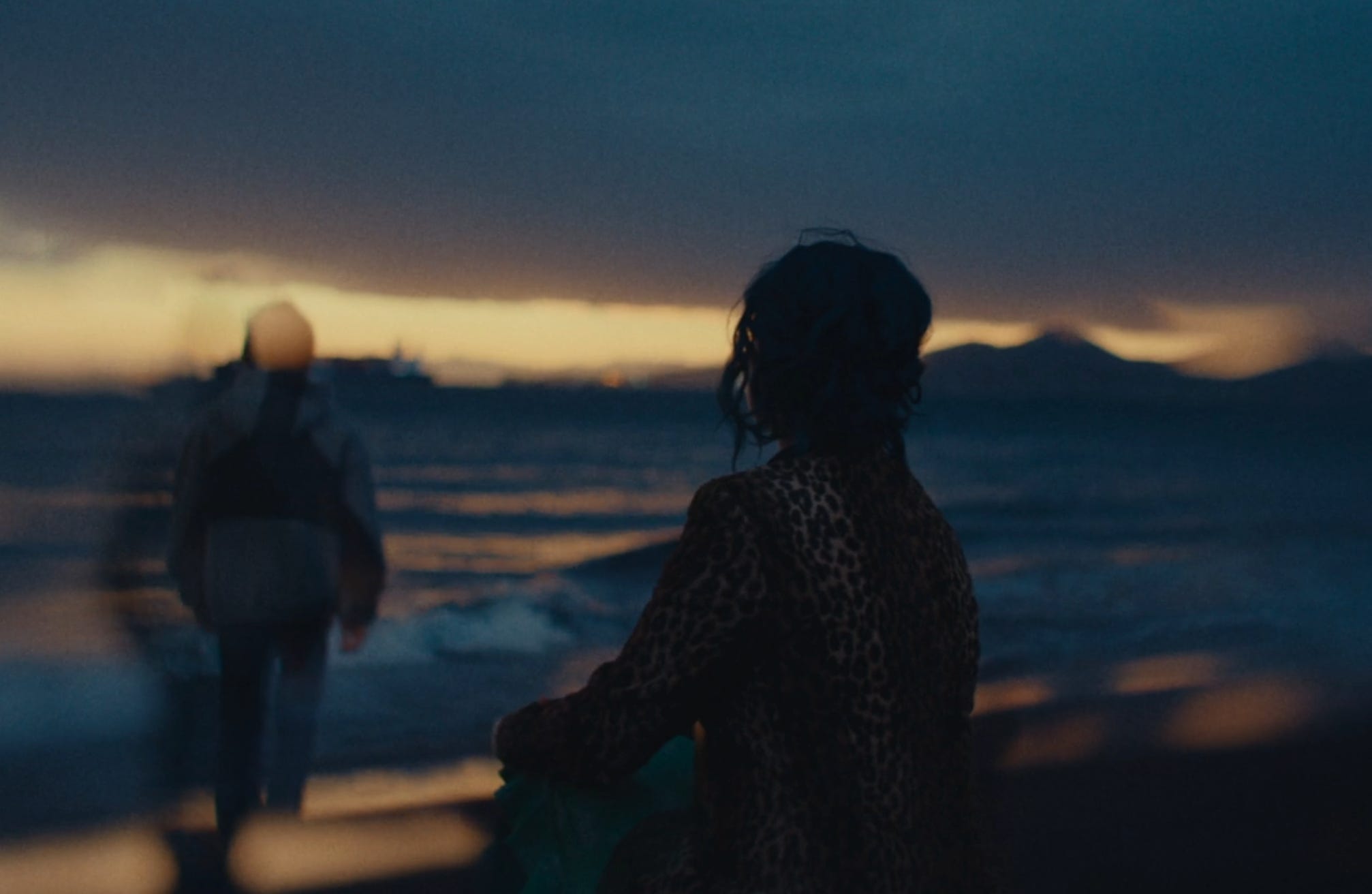
I have been watching and re-watching lots of movies recently, looking for a certain way of editing and writing I have in mind but cannot fully articulate yet. Some titles that I kept returning to are Lars Von Tries’s The Element of Crime and Charlie Kaufman and Eva H.D.’s How to Shoot a Ghost.
The Element of Crime, released in 1984, has a strange way of anticipating many of the ecological collapse we are facing today. The entire film is set in a dark, perennially flooded and seasonless Europe (the sodium-vapor lighting lights were a clever way to overcome budget constraints and give the film a distinct monochromatic, harsh yellow look) that also reminded me of another novel I have been munching on slowly, Private Rites from Julia Armfield.
How to Shoot a Ghost (and its predecessor Jackals and Fireflies) have an interesting editing where images seem to follow the writings more than the action. Words are the true cuts of the film, and images follow to add a visual texture that creates a strange sort of distance for the viewer.
“A book disguised as a movie“, as the writer put it on her website.
If you see something similar, you know where I copied it from.
What’s Next
I am almost done writing the first draft of two of the stories/living labs I want to produce with Under Over Through. The temporary working titles are Last Mile and Solaria. They are both fictions and blueprints for real experiments we should try. Rewriting, prototyping, storyboarding will follow.
More prototyping on hybrid human | AI systems, in particular around reading and writing. I cannot say more but I am interested in the models’ ability to hold and manipulate contexts larger than our cognitive abilities.
Second half of 2026 is more open for teaching, consulting, producing new stories. Email and calendar are open.
Au revoir,
Marco